

When you finally decide you need regular breaks from caregiving, two options usually come up first: an adult day program, where your loved one spends the day at a center, or in-home respite, where a caregiver comes to the house. Both give you time back. They just do it in very different ways.
This guide compares adult day care and in-home respite care side by side: what each one is, who tends to thrive in each, how they’re paid for, and how to decide. Many families end up using both.
What is adult day care?
Adult day care is a daytime program where older adults spend several hours at a community center with planned activities, meals and supervision, then return home in the evening. The Alzheimer’s Association describes adult day centers as a chance for people with dementia to be social and take part in activities in a safe environment, while the caregiver gets a much-needed break (Alzheimer’s Association).
Programs vary a lot. Some focus on social activities, such as music, art, exercise and outings. Others, often called adult day health care, add health services like nursing, therapy and help with personal care. Hours vary by center, and the Alzheimer’s Association notes some are open seven to 10 hours a day, with transportation and meals often provided.
What is another name for adult day care?
You’ll also see adult day services, adult day centers, adult day programs and adult day health care. In California, a Medi-Cal-funded version is called Community-Based Adult Services, or CBAS (more on that below).
What is in-home respite care?
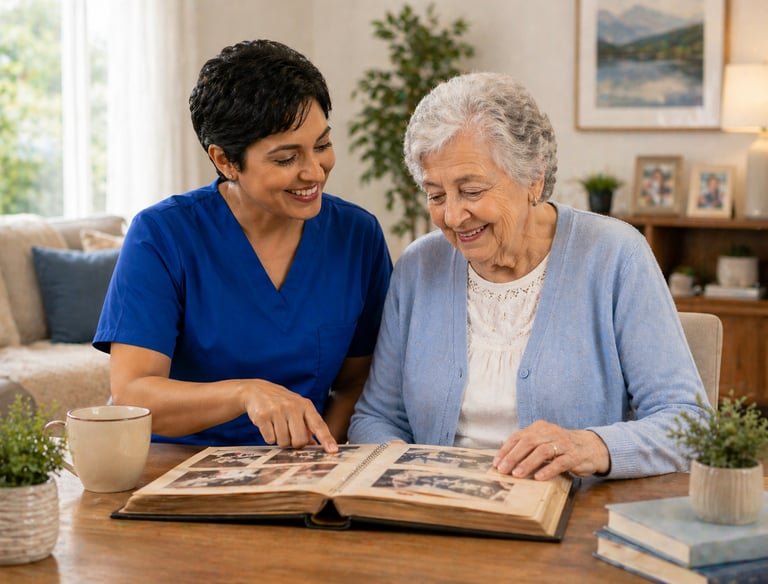
In-home respite means a trained caregiver comes to your loved one’s home so the family caregiver can step away. The person stays in their own space with their own routine. Visits can be short, a full day, overnight, or several days of around-the-clock care. If you’re new to respite in general, our guide to what respite care is covers the basics, including the other forms it takes.
The Alzheimer’s Association lists the kinds of help in-home services can offer, from companionship and supervised activities to help with bathing, dressing and toileting, and homemaker help with laundry, shopping and meals (Alzheimer’s Association).
Is respite care the same as adult day care?
Not exactly. Adult day care is one type of respite. Respite is any short-term care that gives the main caregiver a break, and NIA notes it can take place at home, in a health care facility, or at an adult day center (National Institute on Aging). So every adult day program provides respite, but not all respite happens at a day program.
Adult day care vs in-home respite at a glance
| Adult day care | In-home respite | |
|---|---|---|
| Where | A community center | Your loved one’s home |
| Typical schedule | Weekday daytime hours, set by the center | Built around your schedule, including evenings, overnights and weekends |
| Social time | Group activities with other participants | One-on-one attention and companionship |
| Getting there | Travel each day (some centers provide transportation) | No travel |
| Routine | New setting and group routine | Keeps the person’s own routine and surroundings |
| Attention | Staff look after a group | Undivided attention from one caregiver |
| Best fit | Social, mobile people who enjoy groups | People with memory loss, anxiety, mobility limits, or who resist leaving home |
When adult day care is a good fit
- Your loved one enjoys being around people and is lonely at home.
- You work during the day and need dependable weekday coverage.
- They can manage the trip and a few hours in a group setting.
- They’d benefit from structured activities like exercise or music.
- You want daytime coverage at a lower cost than many hours of one-on-one care.
Expect an adjustment period. The Alzheimer’s Association notes some people resist going at first but often look forward to it after several weeks, and suggests trying a center at least twice a week for a month before deciding (Alzheimer’s Association).
When in-home respite is a better fit
- Your loved one has dementia and gets confused or upset in new places.
- They have trouble walking, tire easily, or the trip itself would be hard.
- You need coverage in the evening, overnight, on weekends or while you travel.
- They need hands-on help with bathing, toileting or transfers.
- They refuse to go to a center but will accept “a friend” coming over.
- You want one consistent caregiver who gets to know them well.
In-home respite also adapts as needs change. A family might start with a few hours a week and add overnights later, all with the same caregiver.
Not sure which option fits your loved one?
How much does adult day care cost?
Costs vary by program and by how many days your loved one attends. As one benchmark, CareScout’s 2025 Cost of Care Survey puts the California median for adult day health care at about $2,037 a month (CareScout Cost of Care Survey, 2025). The Alzheimer’s Association notes many centers offer sliding-scale fees based on income, and some charge extra for things like crafts or field trips (Alzheimer’s Association).
When you compare, ask about the daily fee, minimum attendance, what happens if you miss a day, and whether transportation and meals are included.
Who pays for in-home respite care?
Most families pay for in-home respite privately, by the hour. NIA notes that most private health insurance plans don’t cover respite, that some long-term care insurance plans may, and that Medicaid may help (National Institute on Aging). The cost depends on how many hours you need, the time of day, and the level of care, so it’s worth getting a quote based on your actual schedule.
Locally, Del Oro Caregiver Resource Center can fund respite for eligible family caregivers, either at home or in an out-of-home setting such as a day center, at no cost to the caregiver (Del Oro Caregiver Resource Center). Call (916) 728-9333 to ask about eligibility.
Will Medicare pay for adult day care?
Generally, no. Medicare.gov lists adult day health care as a type of long-term care, and states that Medicare doesn’t pay for long-term care; most health insurance, including Medigap, doesn’t either (Medicare.gov). Medicare.gov points people to Medicaid, if they qualify, or private long-term care insurance instead.
Does insurance pay for adult day care?
Sometimes. Long-term care insurance policies may cover adult day services, so check the policy. In California, Medi-Cal members who meet medical necessity rules may qualify for CBAS, a day health program that the California Department of Aging describes as an alternative to institutional care. CBAS centers offer services such as nursing, therapies, personal care, hot meals and transportation to and from home (California Department of Aging).
Can you combine adult day care and in-home respite?
Yes, and many families do. A common pattern:
- Adult day care two or three weekdays, so the family caregiver can work.
- An in-home caregiver in the morning to help with bathing, dressing and getting out the door on day-program days.
- In-home care in the late afternoon or evening, when many people with dementia have a harder time.
- Overnight or weekend in-home respite when the family caregiver needs sleep or travels.
Combining the two lets your loved one get social time and keeps one-on-one help available for the hours a center doesn’t cover.
Watch: which type of care fits your loved one

Questions to ask before you choose
Whichever option you lean toward, these questions help (several come from the Alzheimer’s Association’s checklist for adult day centers, Alzheimer’s Association):
- What are the hours, fees and services? Is there a minimum number of days or hours?
- Is staff trained in dementia care? How are behaviors like wandering handled?
- Will my loved one see the same staff or caregiver each time?
- How are emergencies handled, and how will I be kept informed?
- Is transportation available, and what does it cost?
- How will you learn my loved one’s routine and preferences?
Choosing a respite option is also a good time to build your own support. Our list of caregiver support groups in the Sacramento area includes in-person and online groups where other caregivers share what’s worked for them.
In-home respite with Premier Comfort Care
Premier Comfort Care provides non-medical in-home respite in Sacramento, Folsom, Roseville, Granite Bay, El Dorado Hills, Elk Grove, Rocklin, Citrus Heights and nearby communities. We can cover the hours a day program doesn’t, from 1–2 hour visits to overnights and several days of around-the-clock care, including weekends and holidays.
Our caregivers are Teepa Snow-trained for Alzheimer’s and dementia care and follow your loved one’s routine and care plan. We focus on keeping the same caregivers in the home, and our caregiver retention is 65%. Families can check in through our family portal, and any unused care credits are fully refunded. When you call, you’ll talk directly with our owner, Mariam.
Let’s find the mix of care that works for your family.
Sources: Alzheimer’s Association, Adult day centers; Alzheimer’s Association, Respite care; National Institute on Aging, What Is Respite Care?; Medicare.gov, Long-term care; California Department of Aging, CBAS; CareScout Cost of Care Survey, 2025; Del Oro Caregiver Resource Center.