

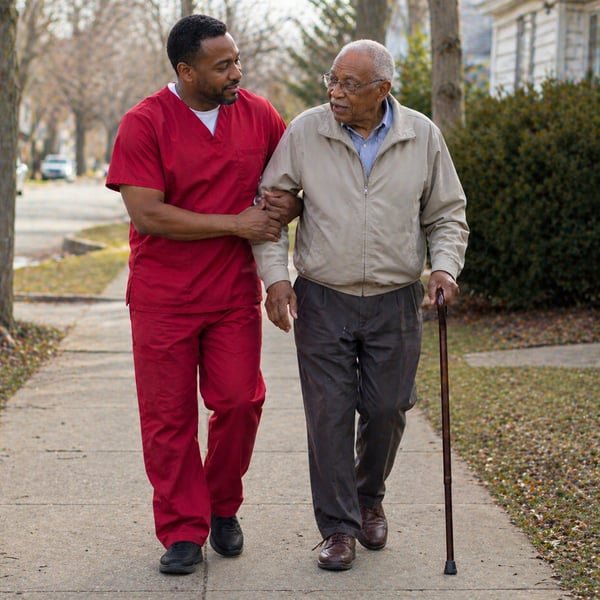
When a parent has Parkinson’s, it’s natural to want to protect them, and sometimes that means doing more for them and letting them move less. But for people with Parkinson’s, staying active isn’t just good for general health. It’s one of the most powerful tools they have.
This guide covers what the Parkinson’s Foundation recommends, the four types of exercise to include, simple ways to stay active at home, how to stay safe, and how a caregiver or Parkinson’s care at home can make it easier to keep going.
Check with your parent’s doctor or a physical therapist before starting a new exercise program.
Why exercise matters so much in Parkinson’s
The Parkinson’s Foundation calls exercise a vital part of managing Parkinson’s, helping maintain balance, mobility and daily activities. It notes that exercise can also ease non-movement symptoms such as depression and constipation (Parkinson’s Foundation).
Its Parkinson’s Outcomes Project found that people with Parkinson’s who started exercising earlier, for at least 2.5 hours a week, had a slower decline in quality of life than those who started later (Parkinson’s Foundation). Neurologists now recommend exercise as part of most Parkinson’s treatment plans.
What is the best exercise for Parkinson’s?
There’s no single best exercise. The Parkinson’s Foundation says there’s no “exercise prescription” that’s right for everyone, and that the most important thing is to exercise regularly, so it’s best to find something your parent enjoys and can stick with (Parkinson’s Foundation).
It recommends that a program include four key types of exercise (Parkinson’s Foundation):
- Aerobic activity, such as walking, cycling or swimming, that raises the heart rate
- Strength training, with light weights, resistance bands or body weight
- Balance, agility and multitasking, such as tai chi, dance or stepping exercises
- Flexibility, through stretching
The Foundation lists biking, running, tai chi, yoga, Pilates, dance, weight training, non-contact boxing and qi gong among activities with positive effects on Parkinson’s symptoms (Parkinson’s Foundation).
Simple exercises to try at home
These ideas are common, low-equipment ways to work on each area. A physical therapist can adjust them for your parent and show the safest technique.
Aerobic
- Walking indoors or outdoors, building up gradually
- A stationary bike or seated pedal exerciser
- Marching in place while holding a counter
- Following along with a Parkinson’s-specific exercise video
Strength
- Sit-to-stands from a sturdy chair with armrests
- Wall push-ups
- Light hand weights or resistance bands for arms and shoulders
- Heel raises while holding the kitchen counter
Balance and agility
- Standing with feet together, then one foot slightly in front, holding a counter
- Side steps and big, deliberate steps along a hallway
- Gentle tai chi or seated dance to music
- Stepping over a line on the floor while counting or naming things (multitasking)
Flexibility
- Shoulder rolls and gentle neck turns
- Seated trunk twists
- Calf and hamstring stretches
- Reaching tall to counter a stooped posture
Watch: making the staircase easier

How to get started safely
The Parkinson’s Foundation’s first tip is to be safe: before starting, see a physical therapist who specializes in Parkinson’s for an evaluation and recommendations (Parkinson’s Foundation). Its other tips:
- Use a step counter to see how many steps your parent takes on an average day, then build from there.
- Exercise indoors and outdoors, and change the routine to stay interested.
- Pick activities your parent enjoys.
- Always stretch, warm up and cool down.
- Know your limits, and exercise in a way that’s safe for you.
For people who have been less active, the Foundation suggests starting with low-intensity exercise such as walking and building up to more vigorous activity as tolerated (Parkinson’s Foundation).
Want someone to walk and exercise with your parent?
What not to do with Parkinson’s
A few safety cautions most families find helpful:
- Don’t exercise alone if balance is poor. Have someone nearby, and keep a sturdy surface within reach.
- Don’t push through dizziness. Stand up slowly; Parkinson’s can cause blood pressure to drop on standing.
- Don’t wear socks or slippery shoes on hard floors.
- Don’t skip warm-ups or stop moving altogether during bad weeks; gentle movement still helps.
- Don’t change medicine timing to fit workouts without asking the doctor.
NINDS notes that balance problems and posture changes in Parkinson’s increase the risk of falls (NINDS). NIA’s general fall-prevention advice applies too: stand up slowly, wear non-skid shoes, and use walking aids that are the right size (National Institute on Aging).
Exercising with a partner
The Parkinson’s Foundation notes that many people achieve the most success exercising with a partner, and that depending on the stage of the disease, it may be best to train where others can help if needed. A partner can also help with motivation (Parkinson’s Foundation).
A partner might be a spouse, an adult child, a friend, a class instructor or a caregiver. Even a daily walk together counts.
Finding a class
Dance and non-contact boxing classes designed for people with Parkinson’s are growing in popularity. The Parkinson’s Foundation Helpline, 1-800-4PD-INFO (1-800-473-4636), can help you find one nearby (Parkinson’s Foundation).
Staying motivated through good and bad days
- Set a regular time, such as after breakfast, when medicines are working well.
- Track progress with steps, minutes or simple goals on a calendar.
- Make it social: walk with a friend, join a class, or exercise to favorite music.
- Mix it up so it doesn’t get boring.
- Celebrate consistency, not intensity. The Foundation notes that programs lasting longer than six months showed significant gains in balance and mobility.
If your parent was only recently diagnosed, starting now matters. Our guide to the early signs of Parkinson’s covers what families notice first and what to ask the doctor.
How a caregiver can help
For many families, the hardest part isn’t knowing what to do; it’s doing it consistently. A caregiver can:
- Go on daily walks and stay close for balance
- Set up the space safely and stand by during exercises
- Encourage the routine the physical therapist recommends
- Help with warm-ups, stretches and cool-downs
- Notice changes in balance, stiffness or fatigue and share them with the family
Adapting exercise as Parkinson’s progresses
The Parkinson’s Foundation notes that people in the early stages tend to be as strong and fit as others their age, but that as Parkinson’s progresses it can bring loss of joint flexibility (which affects balance), decreased muscle strength (which affects walking and standing up), and a decline in cardiovascular conditioning (which affects endurance). Exercise can be adjusted to meet each of these challenges.
As needs change, ideas that help include:
- Seated exercises such as marching, arm circles, leg extensions and trunk twists when standing balance is limited.
- Shorter, more frequent sessions, such as three 10-minute walks instead of one 30-minute walk.
- Exercising at the time of day your parent moves best; ask the doctor how medicine timing affects this.
- A walker or other device recommended by a physical therapist for walks.
- More standby help as falls become more likely.
Exercise for mood and other symptoms
Exercise isn’t only about movement. The Parkinson’s Foundation notes it can ease non-movement symptoms such as depression and constipation, and that exercising enhances a sense of well-being across different stages and severities of the disease. For many people, the social side of a class or a daily walk with someone matters just as much as the physical benefits.
If your parent is feeling low or unmotivated, start very small, celebrate any movement, and mention mood changes to the doctor, since depression and apathy are common in Parkinson’s and can be treated.
Making the home exercise-friendly
A little setup makes it easier to exercise safely every day:
- Clear a space with no rugs, cords or clutter, near a sturdy counter or chair to hold.
- Keep a sturdy chair with armrests for seated work and sit-to-stands.
- Store bands and light weights where they’re easy to reach.
- Make sure the area is well lit.
- Keep water and a phone nearby.
- Post the physical therapist’s exercise sheet where your parent will see it.
When exercise is easy to start, it’s much more likely to happen. Even short sessions add up over a week.
How Premier Comfort Care helps
Premier Comfort Care provides non-medical Parkinson’s care at home in Sacramento, Folsom, Roseville, Granite Bay, El Dorado Hills, Elk Grove, Rocklin, Citrus Heights and nearby communities. Our caregivers help your parent stay active safely, with walks, encouragement and standby support, alongside help with meals, dressing, bathing and medication reminders.
Care can start with 1–2 hour microvisits, a good fit for a daily walk and exercise routine, and grow as needs change, up to 24/7 care including weekends and holidays. We focus on keeping the same caregivers in the home, with 65% caregiver retention. When you call, you’ll talk directly with our owner, Mariam.
Let’s help your parent keep moving.
Sources: Parkinson’s Foundation, Exercise; NINDS, Parkinson’s disease; NIA, Falls and fractures.