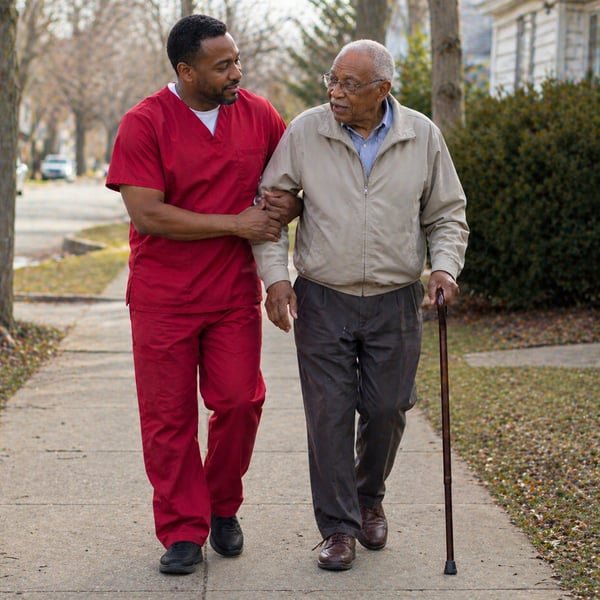


When a parent has a stroke, a spouse comes home from the hospital, or a grandparent’s health suddenly declines, many working Californians face the same hard question: how do I take time off to help without losing my income?
Most people know California’s Paid Family Leave (PFL) as a benefit for new parents, but it also covers workers caring for a seriously ill family member. This guide explains how PFL works for family caregivers, based on the California Employment Development Department (EDD) pages as of November 18, 2026, and how respite care can help you keep your own life going once you return to work.
This article is general information, not legal or financial advice. PFL rules can change; check with the EDD for your situation.
How does Paid Family Leave work in California?
Paid Family Leave provides short-term wage replacement to people who need time off work to bond with a new child, care for a seriously ill family member, or support a family member’s military deployment (California EDD). For caregivers, this is called a care claim.
PFL is paid for through State Disability Insurance (SDI), the deduction that shows up as “CASDI” on most California paystubs. It doesn’t come from your employer, and it pays part of your wages, not all of them.
Who qualifies for PFL care benefits?
According to the EDD, you may qualify for PFL care benefits if you (California EDD):
- Need to care for a family member with a serious health condition
- Lose wages because you need family leave
- Are working or looking for work when your family leave begins
- Work in California and paid into State Disability Insurance in the past 5 to 18 months
- Submit all required documents, including a medical certification
The EDD’s main PFL page adds that you must have earned at least $300 and paid into SDI in the last 18 months (California EDD). Citizenship and immigration status don’t affect eligibility, and where you live doesn’t matter as long as your job is based in California and you pay into SDI (California EDD FAQs).
Which family members are covered?
The EDD lists these eligible family members for care claims: your child, parent, parent-in-law, grandparent, grandchild, sibling, spouse, or registered domestic partner (California EDD).
Can I get Paid Family Leave in California to care for my grandparents?
Yes. Grandparents are on the EDD’s list of eligible family members, as are parents-in-law and siblings.
What counts as a serious health condition?
The EDD defines a serious health condition as an illness, injury, impairment, or physical or mental condition. It can involve inpatient care at a hospital, hospice, residential medical facility or at home; being unable to work, attend school or do daily activities; or continuing treatment connected to inpatient care. Conditions like the common cold, flu, earaches or an upset stomach don’t qualify unless complications arise (California EDD).
Is California Paid Family Leave 6 or 8 weeks?
It’s up to 8 weeks in a 12-month period (California EDD). If you already used part of your 8 weeks in the last 12 months, such as for a bonding claim, you can use what’s left for a care claim. The EDD gives the example of someone who used 4 weeks for bonding and still has 4 weeks available to care for an ill family member (California EDD).
How much does PFL pay?
The EDD says your weekly benefit amount is about 70–90% of the wages you earned 5 to 18 months before your claim, depending on income, up to a maximum. The minimum weekly benefit is $50 and the maximum is $1,765 per week (California EDD). Lower earners receive the higher percentage.
Your amount is based on your highest-earning quarter in the base period, and it can change if you receive other income, like sick pay or PTO, while on PFL. The EDD has an online calculator for an estimate; your actual amount is confirmed when the claim is approved.
Payments aren’t instant. The EDD says it tries to process payment within 14 days of receiving a complete claim, meaning every section filled out, signed and with all required documents (California EDD FAQs).
Planning time off to care for a parent?
How to apply for PFL as a caregiver
The EDD lists these steps for a care claim (California EDD; Step 1):
- Gather your information: personal details and ID, your most recent employer’s information, the last day you worked your normal hours, and any wages you expect while on leave.
- Complete and sign Part A, the Statement of Claimant, online through myEDD/SDI Online or on paper.
- Have your family member sign Part C (or their legal representative), authorizing the care claim.
- Get Part D, the medical certification, completed and signed by your family member’s physician or practitioner. It must establish a serious health condition and a need for care. A nurse practitioner or physician assistant can also certify within their scope of practice.
- File on time: the EDD says to submit your claim no later than 41 days from your first day of family leave.
If you have questions about your claim, the EDD lists the PFL phone line as 1-877-238-4373 (California EDD).
What is the difference between PFL and FMLA in California?
PFL pays benefits; it doesn’t protect your job. The EDD says this directly, and notes that other laws, such as the federal Family and Medical Leave Act (FMLA) or the California Family Rights Act (CFRA), may protect your job (California EDD). Whether those laws apply depends on your employer and your work history, so ask your HR department or check with the agency that enforces them before you take leave.
Do I have to use my sick leave or vacation first?
No. The EDD says that as of January 1, 2025, your employer can’t require you to use sick leave or other paid time off before you get PFL benefits (California EDD FAQs).
Common situations for family caregivers
Can I receive PFL while working part time?
Yes. The EDD says you can apply while working part time or reduced hours if you’ve lost wages and meet the other requirements (California EDD FAQs). Your benefit may be reduced by the wages you still earn. This can be a good fit for caregivers who need a few days a week to manage appointments.
What if my parent lives in another state?
You can still apply. The EDD allows care claims for family members outside California or in another country, as long as their licensed physician or practitioner certifies the need for care (California EDD).
Can my sibling and I both take PFL?
More than one person can be a caregiver, but the EDD says you’ll only receive benefits for the time you are the primary caregiver. Some families stagger their leave so one sibling covers the first weeks and another covers later.
What if I quit my job to care for my parent?
The EDD says you may still qualify if you meet the requirements, including being attached to the labor market 90 days before your claim and having a wage loss because of the care leave. You can’t receive PFL and Unemployment Insurance at the same time (California EDD FAQs).
Do caregivers get paid if caring for parents in California?
PFL is temporary partial pay for workers who take leave. It isn’t a long-term caregiver salary. For longer-term needs, families often look at other options: if a parent has Medi-Cal, the In-Home Supportive Services (IHSS) program run by each county may allow a family member to be paid as a provider, and long-term care insurance policies sometimes cover in-home care. Your county IHSS office or a long-term care insurer can tell you what applies.
If your parent or spouse is a veteran, the VA has its own programs for family caregivers. Our guide to the VA Caregiver Support Program explains who qualifies and how to apply.
Making the most of your leave: caregiver self-care
Eight weeks can go by fast, especially in a medical crisis. Many caregivers spend the entire leave in emergency mode and return to work exhausted, with no plan for what comes next. A few ideas to use the time well:
- Set up the long-term plan early. Use the first weeks to learn what your loved one needs and arrange help that will continue after you go back to work.
- Line up backup. Family, friends, a day program or in-home respite for the days you can’t be there.
- Protect your sleep. If nights are hard, arrange overnight help for at least some nights.
- Get support for yourself. Del Oro Caregiver Resource Center offers free family consultation, short-term counseling and care planning for eligible caregivers in Sacramento, Placer, El Dorado and nearby counties (Del Oro).
- Acknowledge your feelings. Family Caregiver Alliance notes that all of a caregiver’s emotions, good and bad, are valid, and that ignoring them can lead to poor sleep and illness (Family Caregiver Alliance).
If your loved one has dementia, planning breaks takes a little extra care. Our guide to respite care for dementia explains how to keep their routine steady while someone else steps in.
Watch: why it pays to plan early


Help after your leave ends: Premier Comfort Care
When your Paid Family Leave ends, the care your loved one needs usually doesn’t. Premier Comfort Care provides non-medical in-home care and respite in Sacramento, Folsom, Roseville, Granite Bay, El Dorado Hills, Elk Grove, Rocklin, Citrus Heights and nearby communities, so you can return to work knowing someone dependable is there. Care can be scheduled around your work hours, from 1–2 hour visits to overnights and around-the-clock care, including weekends and holidays.
Our caregivers are Teepa Snow-trained for Alzheimer’s and dementia care, and we work to keep the same caregivers in the home, with 65% caregiver retention. You can check in through our family portal from work, and when you call, you’ll talk directly with our owner, Mariam.
Let’s plan care that lets you get back to work.
Sources (all checked November 18, 2026): California EDD, Paid Family Leave; California EDD, Paid Family Leave for caregivers; California EDD, PFL benefit payment amounts; California EDD, PFL eligibility FAQs; California EDD, Step 1; Family Caregiver Alliance; Del Oro Caregiver Resource Center.