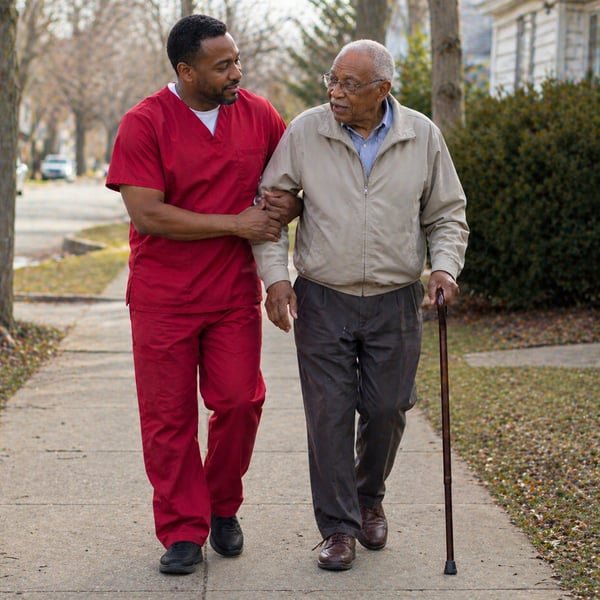


You promised “in sickness and in health,” and you meant it. But nobody explains what it’s like when your husband needs help getting dressed, or your wife with dementia asks who you are. Spouse caregivers often do the most hands-on care of anyone, with the fewest breaks, because the person they care for is right there, all day and all night.
This guide is for husbands and wives caring for a partner. It covers what happens when a spouse becomes a caregiver, whether you can be paid, how to keep your relationship alive alongside the care, and how to get real breaks, including through respite care, when you live with the person you care for.
What happens when a spouse becomes a caregiver?
The relationship shifts, often slowly. The Alzheimer’s Association describes how a spouse or partner may take on more responsibilities and decision-making than before, when the two of you used to operate as a team, and notes that you may feel enormous grief over those changes, which doesn’t make you selfish (Alzheimer’s Association).
Common changes spouse caregivers describe:
- Taking over tasks your partner always handled, such as finances, driving or home repairs
- Helping with intimate personal care such as bathing and toileting
- Losing the partner you used to confide in, even while they’re still beside you
- Fewer outings, friends and plans of your own
- Interrupted sleep from night-time needs
- Worry about money and the future
NIA notes that a primary caregiver, especially a spouse, may be hesitant to ask for a break (National Institute on Aging). That reluctance is one of the biggest risks spouse caregivers face.
Caring for a husband or wife with dementia
Dementia changes a marriage in particular ways. The Alzheimer’s Association notes that you may no longer share the same emotional or physical intimacy, that dementia can change a person’s interest in sex in either direction, and that it’s common for caregivers to lose desire too because of the demands of caregiving and the shift from partner to caregiver. It encourages caregivers not to feel guilty and to find new ways to connect (Alzheimer’s Association).
A few things that often help:
- Keep shared pleasures you can still enjoy together: music, old photos, a drive, a favorite meal.
- Respond to feelings, not facts. Correcting your spouse rarely helps; reassurance usually does.
- Use simple, calm communication and give time to respond.
- Talk about wishes early, while your spouse can still take part, and put legal and financial documents in order.
- Learn about the disease so behaviors feel less personal.
The Alzheimer’s Association’s 24/7 Helpline, 800.272.3900, can help with care planning, managing stress and communication.
Can you get paid to be your spouse’s caregiver?
Sometimes, depending on your situation:
- VA programs. If your spouse is a veteran who qualifies, the VA’s Program of Comprehensive Assistance for Family Caregivers includes a monthly stipend for an eligible primary caregiver, and spouses are among the eligible family members. Our guide to the VA Caregiver Support Program explains the rules.
- Medi-Cal (IHSS). If your spouse has Medi-Cal, ask your county In-Home Supportive Services office whether a family member, including a spouse, can be paid as the provider in your situation.
- California Paid Family Leave. If you work and pay into State Disability Insurance, PFL may provide partial wage replacement while you take time off to care for a seriously ill spouse or registered domestic partner (California EDD).
- Long-term care insurance. Some policies pay for care at home; check whether family members can be paid under your spouse’s policy.
Does Medicare pay spouse caregivers?
No. Medicare.gov states that Medicare doesn’t pay for long-term care, meaning help with daily activities such as bathing, dressing and using the bathroom, and that people may get that help through Medicaid if eligible, or through private long-term care insurance (Medicare.gov).
Keeping your marriage, not just the care routine
It’s easy for every conversation to become about pills, appointments and symptoms. Protect a little time each week that’s just about the two of you:
- Share a coffee, a show or a walk without doing any care tasks.
- Let someone else handle the most intimate personal care some of the time, so you can be a husband or wife first.
- Look through photo albums or play music from earlier in your marriage.
- Celebrate anniversaries and birthdays, even in small ways.
- Hold hands. Touch often says what words can’t.
Family Caregiver Alliance notes that caregivers often bury “negative” feelings such as resentment or loneliness out of fear of being judged, and that acknowledging all your feelings, good and bad, helps you cope better (Family Caregiver Alliance).
Want to be a spouse again for a few hours each week?
Getting breaks when you live with the person you care for
Spouse caregivers often go months without time alone, because there’s no “leaving work.” NIA describes respite as short-term relief that can last from a few hours to several weeks, at home, in a facility or at an adult day center (National Institute on Aging). Ideas that work for couples:
- A regular weekly break at the same time, so it’s part of the routine for both of you.
- Leave the house. If the caregiver comes to your home, use the time to go out, not to do chores in the next room.
- Overnight respite if night-time needs are wearing you down.
- Adult day programs for spouses who enjoy social time.
- Ask family to take a specific shift rather than offering “to help anytime.”
NIA suggests that if someone offers to help, practice saying, “Thanks for asking. Here’s what you can do” (National Institute on Aging).
Watch your own health
Spouse caregivers are often older themselves and may be managing their own health conditions. The Alzheimer’s Association lists 10 signs of caregiver stress, including exhaustion, sleeplessness, irritability, social withdrawal and new health problems, and recommends talking to your doctor if you notice them regularly (Alzheimer’s Association).
- Keep your own medical appointments.
- Ask your doctor about sleep problems or low mood.
- Eat regular meals and move every day, even briefly.
- Have a backup plan for who would step in if you got sick.
Support made for spouses
- Well Spouse Association, a national group for people caring for a husband, wife or partner (800-838-0879; listed by NIA, NIA).
- Alzheimer’s Association support groups and ALZConnected, including in-person and online options in the Sacramento area.
- Del Oro Caregiver Resource Center (916-728-9333), with free counseling, consultation and funded respite for eligible caregivers in Sacramento, Placer, El Dorado and nearby counties.
- Faith communities and friends who can offer company, meals or rides.
When your spouse resists help from others
Many husbands and wives don’t want “a stranger” helping with care, or feel their spouse should be the one to do it. Resistance is common and doesn’t mean help can’t work. Some approaches that often make it easier:
- Start small, with a short visit while you’re home.
- Introduce the caregiver as a friend or helper for one task, such as lunch or a walk.
- Keep the same caregiver and the same time each week so the visit becomes routine.
- Frame it as something for you: “I need a little help so I can keep taking care of you.”
- Let your spouse keep as much control as possible over choices like meals and activities.
Planning for the future together
If your spouse can still take part, talk about the future while you can make decisions together. The Alzheimer’s Association recommends locating financial and legal documents, such as life insurance policies, property deeds and retirement accounts, soon after a dementia diagnosis, and documenting the person’s wishes so you can feel confident their preferences will be honored. These conversations are hard, but many couples find they bring peace of mind.
Asking family for help
Adult children and other relatives often want to help but don’t know how. Be specific: ask one person to handle prescription pickups, another to sit with your spouse every other Saturday, and another to call you once a week just to check in. Specific requests are far easier to say yes to than a general “let me know if you need anything.”
How Premier Comfort Care helps
Premier Comfort Care provides non-medical respite care at home in Sacramento, Folsom, Roseville, Granite Bay, El Dorado Hills, Elk Grove, Rocklin, Citrus Heights and nearby communities. Spouse caregivers can start with a few hours a week to see friends, keep their own appointments or simply rest.
Our caregivers are Teepa Snow-trained for dementia care, and we focus on keeping the same caregivers in the home, with 65% caregiver retention, so your husband or wife gets to know a familiar face. Visits range from 1–2 hours to overnights and several days of around-the-clock care, including weekends and holidays. When you call, you’ll talk directly with our owner, Mariam.
Watch: small habits and good advice for caregivers


You’ve been there for them. Let us be there for you.
Sources: Alzheimer’s Association, Changes to your relationship; Alzheimer’s Association, Caregiver stress; National Institute on Aging, What Is Respite Care?; Family Caregiver Alliance, The emotional side of caregiving; Medicare.gov, Long-term care; California EDD, PFL for caregivers.